Gardening on a slope isn't about fighting gravity; it's about working with it. The secret is turning that tricky incline into a stunning, multi-layered landscape using smart design choices like terracing, clever planting, and managing water flow. Get it right, and you’ll create a stable, beautiful garden that a flat patch of lawn could only dream of.
Turn Your Sloping Garden From Problem to Masterpiece
Let's be honest, staring up at a sloping garden can feel a bit daunting. But that incline? It’s your greatest asset. It’s a ready-made opportunity to create a dynamic, visually interesting space that standard, level gardens just can't compete with. We’re going to move past the usual worries—water runoff, soil erosion—and reframe them as design puzzles with elegant, practical solutions.
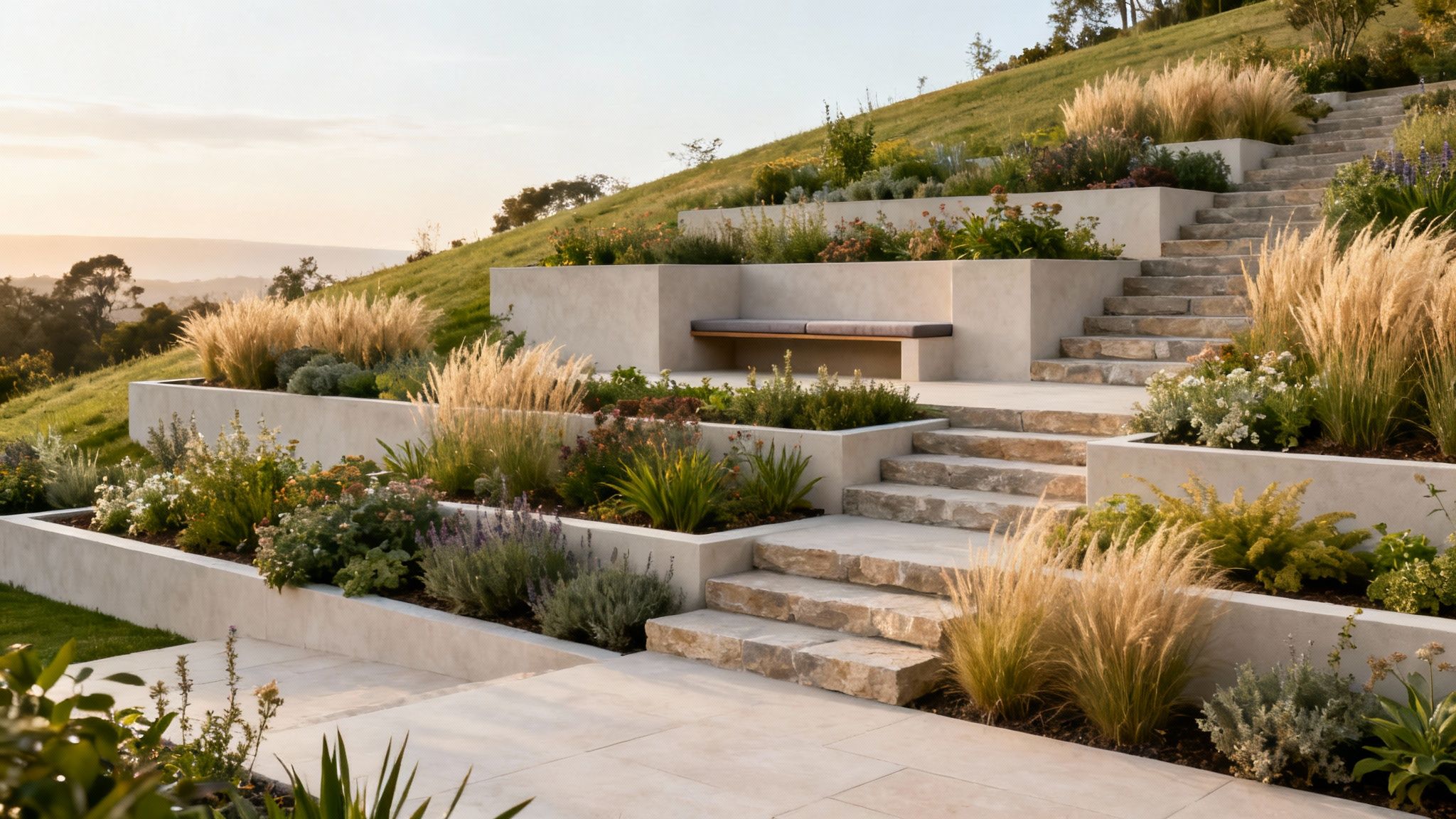
This guide is packed with real-world strategies that actually work, from building sturdy terraces to choosing plants that will anchor the soil like glue. The key is to start with a solid plan. A bit of thought upfront prevents costly mistakes down the line and sets the stage for a thriving hillside garden. Understanding your space is the first step, and our guide on how to plan a garden layout is the perfect place to start.
Why Slopes Present a Unique Opportunity
A sloping garden lets you play with height, texture, and perspective in ways flat-ground gardeners can only imagine. That natural gradient creates distinct microclimates all over your garden, opening up a whole world of planting possibilities.
- Better Drainage: The upper levels are often drier and sunnier, making them perfect for sun-loving, drought-tolerant plants that would rot in a flat, damp bed.
- Visual Drama: Think winding paths, hidden seating areas, and terraces that create focal points and a real sense of journey through the space.
- Layered Planting: You can design a cascading display of colours and forms that flow down the hillside, changing beautifully with the seasons.
A well-designed sloped garden isn't just a solution to a tricky plot; it's a statement piece. It transforms a difficult site into the most captivating feature of your home, blending structural integrity with effortless natural beauty.
Let’s not forget the UK weather. Soil erosion is a very real challenge here, made worse by our famously variable rainfall. It’s not just a farming issue; data shows that around 20% of England's agricultural land, much of it sloped, is at moderate to high risk from water erosion. This mirrors the exact problems we face in our own back gardens. You can discover more insights about UK soil challenges on the-independent.com. By understanding these risks, you can put the right strategies in place to create a resilient, beautiful landscape built to last.
Read Your Landscape Before You Start Digging
Let’s be honest, the long-term success of your sloped garden comes down to what you do before a single shovel touches the dirt. A proper site assessment isn’t just a nice-to-have; it's the absolute foundation for a garden that works with your landscape, not against it. Taking the time now to really look and measure will save you from a world of expensive headaches later.
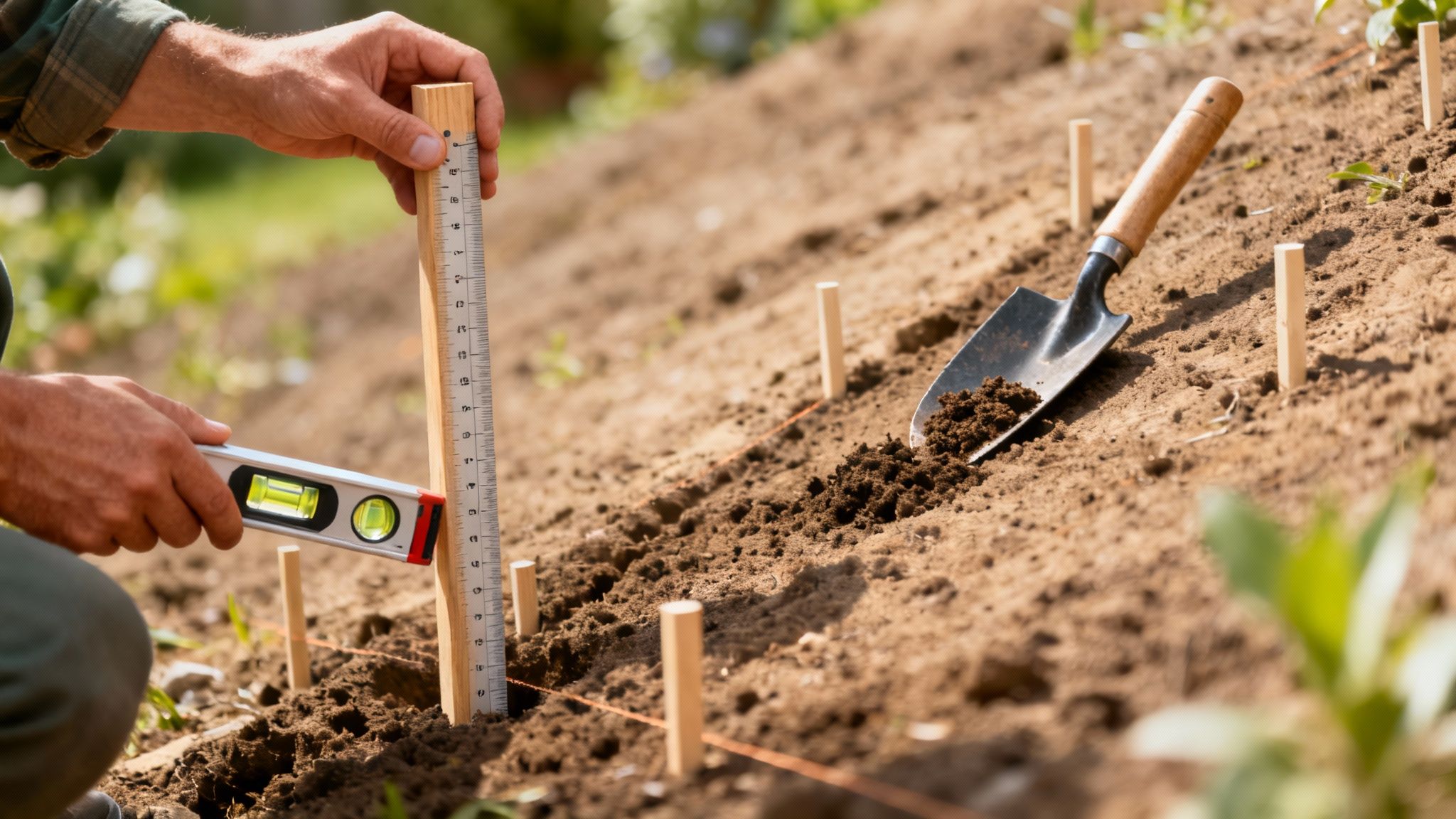
This initial intel gathering is your blueprint for everything that follows, from choosing the right plants to deciding which erosion control methods make sense. It’s all about learning to read the unique story your patch of land is telling you.
Measure Your Slope Gradient
First things first, you need to get a real sense of just how steep your slope is. A gentle incline needs a completely different touch to a sharp drop. As a rule of thumb, most plants need a slope of less than 45 degrees to get their roots properly established without major structural help.
There's a surprisingly simple way to figure this out:
- Grab a one-metre-long board or straightedge and place it on the slope, pointing straight downhill.
- Pop a spirit level on top and adjust the board until it’s perfectly horizontal.
- Now, measure the vertical gap from the downhill end of the board to the ground. This number gives you the 'rise' for your one-metre 'run'.
If you measure a rise of 30cm over that 100cm run, for example, you’re looking at a 30% grade. That's pretty steep and a clear sign you’ll need to think about structural support like terracing.
Understand Your Soil Composition
Soil is everything in a garden, but on a slope, its structure is even more critical. Does it cling to water, or does every downpour wash straight through it? Is it heavy clay that turns to bog, or sandy soil that’s dry moments after it rains?
Knowing your soil type is the key that unlocks your plant choices and watering strategy. Heavy clay might create a soggy patch at the bottom of the slope while the top is bone-dry, effectively creating two different gardens in one small space.
A classic "jar test" will give you a surprisingly clear picture. Just fill a large jar about one-third full with soil from your slope, top it up with water, give it a really good shake, and then leave it to settle for 24 hours. The layers that form tell the story: sand on the bottom, silt in the middle, and clay on top.
Once you know what you’re working with, you’ll have a much better idea of how to prepare soil for planting to give your new garden the best possible start.
Map Sun and Water Movement
Finally, it’s time to play detective. Spend a day (or even a few) just watching how the sun moves across your slope. Make a note of which spots get baked in the harsh afternoon sun and which stay in the cool shade. This little map will be invaluable for putting the right plant in the right place.
Then, after the next good rain, head outside and watch where the water goes. You’ll quickly spot the little channels where it rushes fastest – your potential erosion hotspots – and the areas where it tends to puddle. This is crucial for planning any drainage and for positioning thirsty plants where they can catch a bit of extra moisture.
Anchor Your Garden with Smart Erosion Control
Right, you’ve sussed out the lay of the land. Now for the real graft: making sure your garden actually stays put. When you're gardening on a slope, holding onto your precious topsoil and new plants is everything. It's the foundation of the whole project.
The best approach is a smart mix of structural strength and the power of nature itself, creating a garden that will stand firm for years to come.
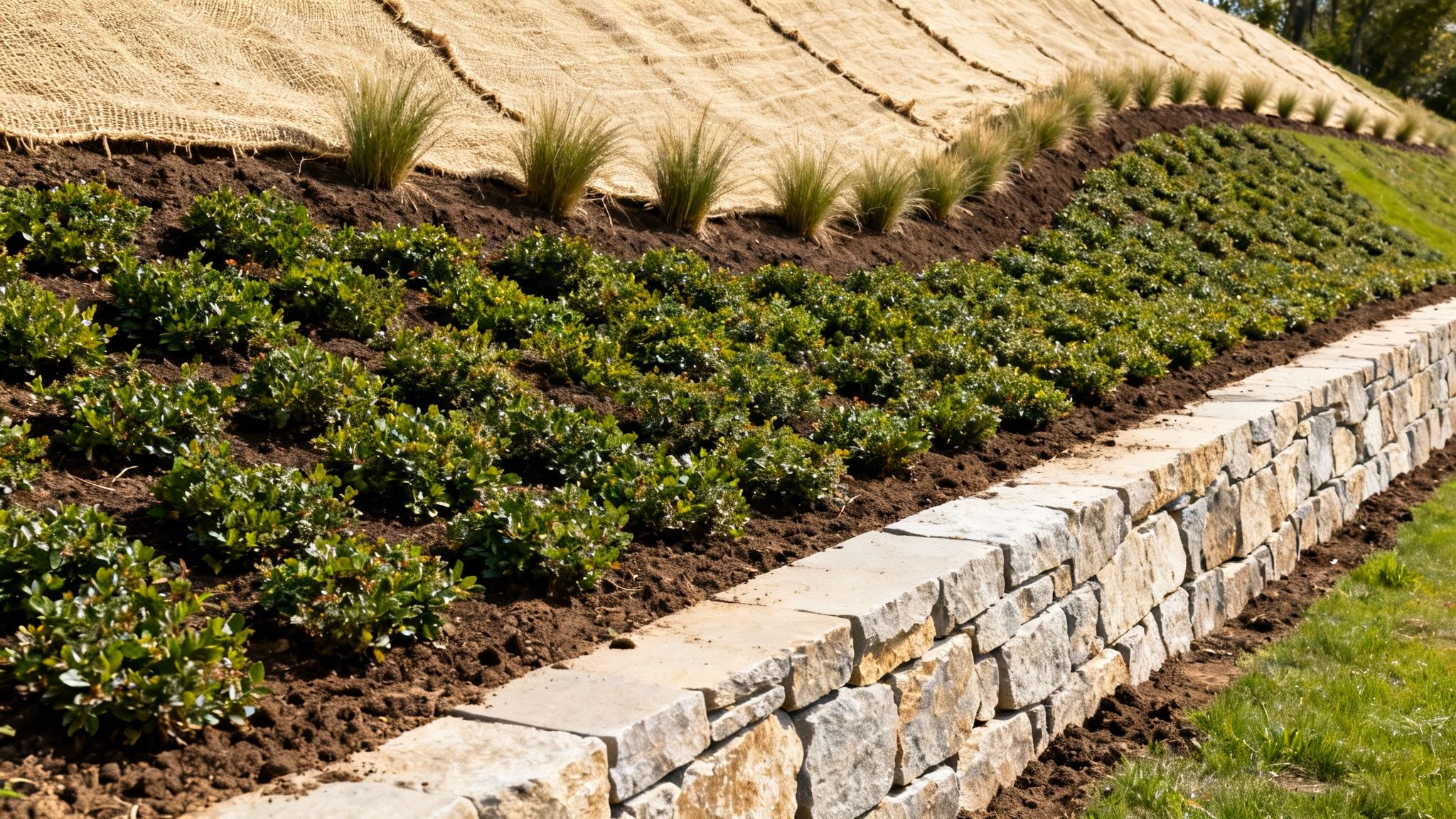
This means blending hardscaping (the bones of your garden) with softscaping (the living, breathing plants). Get this combination right, and you’ll build a resilient, beautiful landscape that laughs in the face of gravity and heavy downpours.
Hardscaping Solutions for Stability
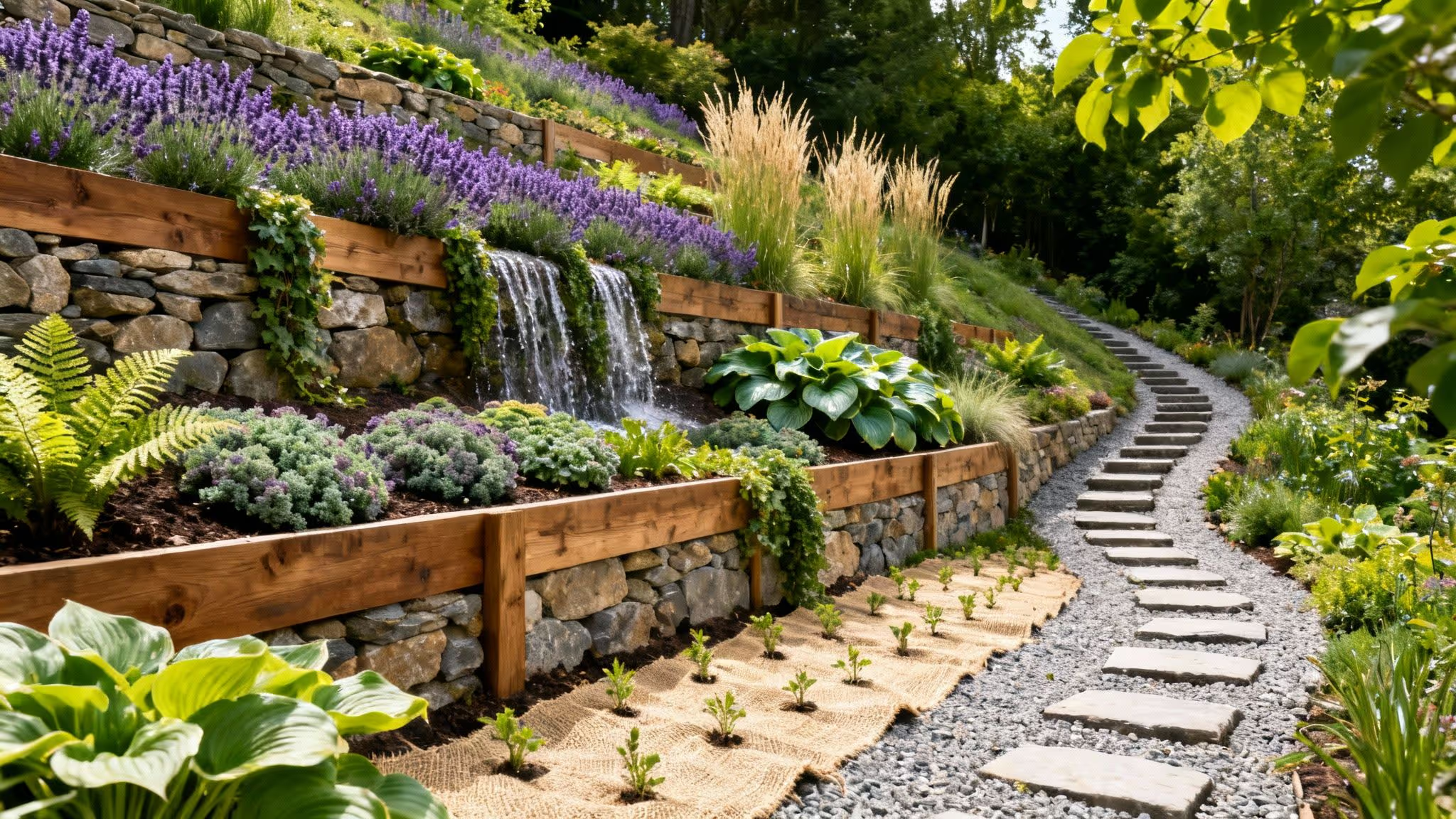
On steeper inclines, you'll almost certainly need some kind of structural support. This is where terracing really shines, turning a daunting hill into a series of level, easy-to-manage planting beds. Think of it as building a staircase for your plants.
- Railway Sleepers: Whether reclaimed or new, sleepers are a brilliant, cost-effective way to build strong terrace walls. They lend a rustic charm and create clean, geometric lines that are surprisingly easy to work with.
- Stone Walls: For a timeless, natural look, nothing beats a dry-stack or mortared stone wall. It’s a serious investment in both time and money, but the durability and beauty are second to none.
To pull the whole look together, try matching the materials from your terraces with any paths or steps. We’ve got plenty of inspiration in our guide to flower bed edging ideas, many of which can be adapted for building terraces.
For particularly steep or unstable slopes, a full-blown retaining wall might be your only option. It’s a major undertaking, but it provides the ultimate in soil retention and can become a dramatic, functional centrepiece in your garden design.
Softscaping: A Living Anchor
While structures provide the framework, it’s the plants that act as the living glue, truly holding a slope together. Their root systems create a natural, self-sustaining net that binds the soil particles.
One of the cleverest tricks is contour planting. Instead of planting in straight lines up and down the hill, arrange your plants in rows that follow the natural curves of the slope. This simple shift creates a series of mini-dams that slow rainwater, reducing its power to erode and giving it a chance to soak in.
Another great tool, especially for protecting bare soil while new plants get settled, is jute matting. This biodegradable mesh holds the earth in place and stops it from washing away in the first downpour. You just plant straight through it, and the matting will slowly rot away as your plants grow and take over the job.
Finally, choose your plants wisely. You’re looking for things with tough, sprawling root systems.
- Dense Groundcovers: Plants like Creeping Thyme or hardy Geraniums spread quickly to form a thick, soil-hugging carpet.
- Ornamental Grasses: The roots of something like Switchgrass (Panicum virgatum) can plunge three feet deep, providing incredible stability.
- Spreading Shrubs: Low-growing Cotoneaster or Juniper hug the ground, anchoring large areas with their woody roots.
Think of plant roots as a dense, fibrous web that holds everything together. A well-chosen groundcover with deep, spreading roots can stabilise an entire bank more effectively than any temporary fix.
By combining these hard and soft techniques, you’re creating a layered defence against erosion. It's how you turn a challenging slope into a secure and thriving garden.
Erosion Control Methods at a Glance
Choosing the right method can feel overwhelming. This little table breaks down the most common options to help you decide what's best for your garden and your budget.
Ultimately, the best solution is often a combination of these strategies, tailored to the specific challenges of your garden. A mix of structural support and clever planting gives you the best of both worlds: stability and natural beauty.
Select Plants That Thrive on an Incline
This is where the magic really happens. Choosing the right plants is less about chasing trends and more about smart, strategic selection. The perfect plant for an incline isn’t just a pretty face; it’s a hardworking partner, anchoring soil and thriving in conditions that would make a typical border plant give up.
Success in gardening on a slope comes down to one golden rule: right plant, right place. A common mistake is treating the entire bank as one uniform space. In reality, an incline creates its own little microclimates—the top is often sun-baked and dry, while the base can be a moisture trap.
Think of your planting scheme as assembling a team. Every plant needs a job, whether that’s binding soil with a dense web of roots, spilling over a wall to soften its edges, or simply looking fabulous in a spot where not much else will grow.
Plants for Anchoring and Groundcover
Your first line of defence against erosion is a living carpet of plants with tough, fibrous root systems. These are your workhorses. They spread to form a dense mat that literally knits the topsoil together, stopping it from washing away in the next downpour.
Look for perennials known for their soil-binding superpowers. Hardy Geraniums, like the ever-popular 'Rozanne' or our native Bloody Cranesbill (Geranium sanguineum), are fantastic choices. Their deep, spreading roots give you excellent stability, and their flowers provide months of colour.
A few other brilliant options include:
- Creeping Thyme (Thymus serpyllum): A tough, low-growing herb that hugs the ground, doesn't mind a bit of foot traffic, and smells divine when you brush past it.
- Vinca minor (Lesser Periwinkle): A brilliant evergreen groundcover for year-round stability, though you’ll need to keep an eye on it to stop it from taking over.
- Ajuga (Bugleweed): Forms dense rosettes of foliage and sends out runners, making it a champion for quickly covering bare ground, especially in shadier spots.
The secret to a really stable slope is all in the layering. Mix deep-rooted perennials with fast-spreading groundcovers. This creates an interlocking web of roots at different soil depths, giving you maximum protection against whatever the weather throws at it.
Drought-Tolerant Heroes for the Top Tiers
The top of a slope is often the most brutal environment in the garden. It gets battered by sun and wind, and water drains away in a flash, creating dry, almost baked conditions. This is the perfect spot for plants that have evolved to cope with less water.
You can't go wrong with the classics like Lavender, Rosemary, and Sedum (Stonecrop). Their silvery foliage and waxy leaves are clever adaptations that help them hang onto every drop of moisture. Ornamental grasses like Stipa tenuissima (Feather Grass) also love it up here, adding beautiful, graceful movement while their roots get busy stabilising the soil.
If you’re after more ideas, our guide on drought-tolerant plants for UK gardens has plenty of inspiration.
Moisture-Lovers for the Base
Down at the bottom of your slope, it’s a completely different story. This is where moisture and precious topsoil naturally end up, creating a richer, damper patch of ground that would be a death sentence for the sun-worshippers at the top. But it's the perfect home for thirstier species.
Hostas are a superb choice for the base, especially if it's a bit shady. Their big, lush leaves create a tropical feel and are brilliant for suppressing weeds. They absolutely relish the damp soil, and their chunky root systems add another layer of stability.
Ferns, like the native Hart's Tongue Fern (Asplenium scolopendrium), also flourish in these cooler, moister conditions, adding wonderful texture. And don't forget Astilbes – they send up fluffy plumes of colour in summer and adore the consistently damp ground found at the foot of an incline.
Here’s a quick-reference table to help you get started with your planting plan.
Plant Selection Guide for Sloped Gardens
A curated list of plants suited for different conditions on a slope, helping you choose the perfect options for sun exposure, soil type, and erosion control.
Choosing the right plant for the right spot isn't just about survival; it's about creating a garden that works with the landscape, not against it. This approach will save you time, water, and heartache in the long run.
Create Safe and Stylish Garden Pathways
Let's be honest, a beautiful hillside garden is pointless if you can't actually get into it to enjoy the view. When you're gardening on a slope, pathways aren't just a nice extra – they're the backbone of the entire design, giving you safe access and a sense of structure.

The trick is making them feel like they belong, rather than looking like a clumsy add-on. For gentle slopes, a meandering path slows the pace and reveals different parts of your planting as you walk. On steeper bits, properly built steps are a must, turning what could be a tricky climb into a lovely stroll.
It's all about that perfect blend of safety and style, making sure every trip through your garden is a pleasure, not a scramble.
Choosing Your Path Materials
The material you pick sets the whole tone for your paths. It also has a big impact on your budget and how much upkeep you'll be doing down the line. Each one has its own pros and cons for a sloped garden.
- Wood Chips or Bark: A brilliant, budget-friendly choice that looks completely natural, especially in a woodland-style garden. It offers fantastic grip but does need topping up every year or so as it breaks down and settles.
- Gravel or Slate Chippings: These are great for stability and drainage, and they mould beautifully to gentle curves. The non-negotiable here is good edging – without it, your stones will forever be escaping downhill into your flowerbeds.
- Stone Slabs or Pavers: This is the most permanent and polished option. It creates a solid, stable walkway that's built to last. The initial cost and effort are higher, no doubt, but you get unmatched stability and a really premium finish.
Think about the journey, not just the destination. On longer or steeper routes, build in little landings or wider sections. They create a natural place to pause, catch your breath, and maybe pop a bench or a big pot with a view.
Ensuring Solid and Safe Footing
Safety is everything when you're building a path on an incline. A solid footing is what stops slips and trips, and it ensures your path doesn't shift and buckle after a season of heavy rain or frost.
With gravel, a properly compacted sub-base is essential to stop the stones moving around under your feet. For stone slabs or steps, each one has to be laid dead level on a firm bed of hardcore and sand. If one wobbles, you've created a trip hazard.
Good drainage is another safety must-have. A path that turns into a mini-river in a downpour is dangerous and will quickly wash away. You can either build a slight camber (a gentle curve from the centre to the edges) or add subtle drainage channels to guide water away from the path and into your beds where it's needed. This simple step protects both the path itself and the surrounding soil.
Smarter Maintenance for a Lasting Landscape
Keeping a sloped garden looking good is less about hard work and more about smart habits. With gravity and water runoff as your constant companions, the usual maintenance routine needs a bit of a rethink to keep your landscape healthy and stable for the long haul.
It really comes down to working with the incline, not fighting it. A few clever techniques can make a world of difference, helping your garden mature beautifully without demanding back-breaking effort every weekend.
Strategic Watering and Mulching
Water is gold in any garden, but on a slope, it has a nasty habit of disappearing downhill before your plants get a decent drink. The trick is to water slowly and deeply, right where it’s needed at the soil level.
Laying soaker hoses along the contours of your terraces is a game-changer. This method delivers water straight to the roots, which means less evaporation and, crucially, no runoff washing your precious soil away.
Mulch is your absolute best friend on a slope. A generous, 5-7cm layer of organic stuff like bark chips or compost does three jobs at once: it holds onto moisture, keeps weeds down, and acts as a shield against the battering force of heavy rain.
Feeding Plants and Managing Growth
Feeding on an incline needs the same careful approach. Granular fertilisers can easily wash away in the first downpour, which is a waste of time and money. Instead, try slow-release pellets pushed gently into the soil near each plant, or use a liquid feed applied directly at the base. This way, the nutrients actually get to your plants.
Those vigorous groundcover plants are brilliant for holding soil together, but sometimes they do their job a little too well. Keep an eye on them to make sure they're not bullying your less thuggish perennials. A quick trim around the edges once or twice a season is usually all it takes to keep everything balanced and looking sharp.
Finally, get into the habit of doing a few seasonal checks.
- Inspect Structures: After a rough winter or big storms, take a walk around. Check that retaining walls, railway sleepers, and path edgings are still solid and haven't shifted.
- Top Up Mulch: Have a look at your mulch levels in spring and autumn. Top up any bare patches to keep that protective layer consistent.
- Plan Ahead: Knowing what to do and when is half the battle. Following a UK gardening calendar is a great way to stay on top of seasonal tasks and make sure you're doing the right job at the right time.
Your Sloped Garden Questions Answered
Let's be honest, staring up at a steep, bare slope can feel a bit daunting. We get it. Here are some quick answers to the questions we hear all the time about gardening on an incline, turning that tricky patch into your garden's best feature.
How Steep Is Too Steep for Planting Directly?
There comes a point where gravity just wins. Generally, once a slope hits a gradient of about 45 degrees, planting straight into it becomes a real battle.
At this angle, any soil, compost, or mulch you add will simply slide to the bottom with the first downpour. It also makes it incredibly tough for new plants to get their roots established. For anything this steep, you're better off looking at building terraces or putting in a retaining wall. It’s a bit more work up front, but it’s the only sustainable way forward.
Can I Just Tip a Load of Topsoil onto a Bare Slope?
It’s tempting, I know, especially if the existing soil looks poor. But please don’t! Piling a thick layer of fresh, loose topsoil onto a slope is like asking for it to wash away in the next heavy rain. You’ll just end up with a muddy mess at the bottom of the garden.
The smarter move is to work with what you’ve got. Dig in plenty of good-quality compost and well-rotted organic matter. This will gradually improve the existing soil’s structure and fertility, making it a much more stable and welcoming home for your plants.